How to write a resume

Having a perfectly honed and well-written resume is like having a superpower during your job search.
While most people walk up the hiring ladder, you put on your crimson cape and soar upwards at supersonic speed. This how to write a resume guide outlines the most important building blocks for creating exactly this type of amazing resume.
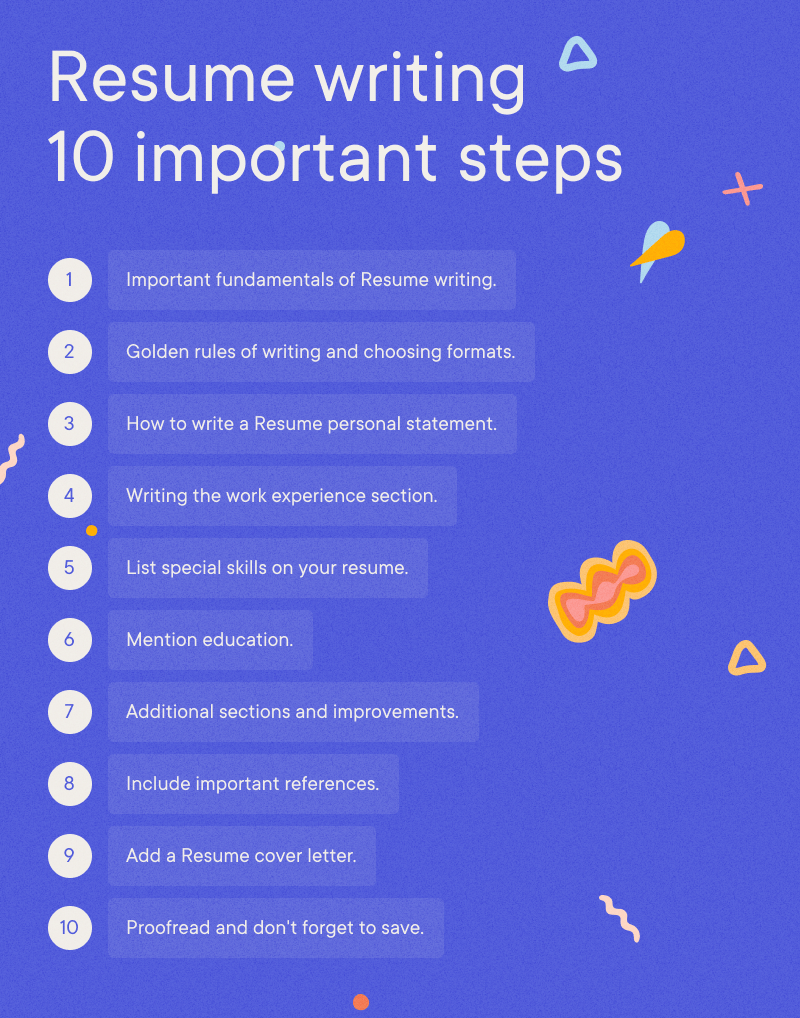
There are the 10 important resume writing steps we will cover in this blog:
A note about the authors: Resume.io's job-winning resume templates have helped 5 million job seekers around the world write a great cv . Our team is dedicated to empowering you in your quest for an amazing career... as well making this journey easy and enjoyable!
Imagine two great professionals with awesome credentials, talents and expertise. Except that one gets ignored by potential employers and stumped by automated application systems. While the other gets several interview calls each week from industry leaders.
What’s the difference between the two people? It could be connections or circumstance. But often, the difference is a great resume that “hacks” hiring situations. Marketing is just as important for professionals as it is for businesses. Present yourself as the obvious choice for the role.
It’s often the little things in life that matter the most.
The vital starting point: where to write your resume?
We’ll go straight to the golden rule, no beating around the bush.
Do not use basic text editors to write the final version of your resume. You can use them to craft your initial thoughts if you feel comfortable with them, but MS Word, Excel and similar programs have a host of potential problems that may hinder you.
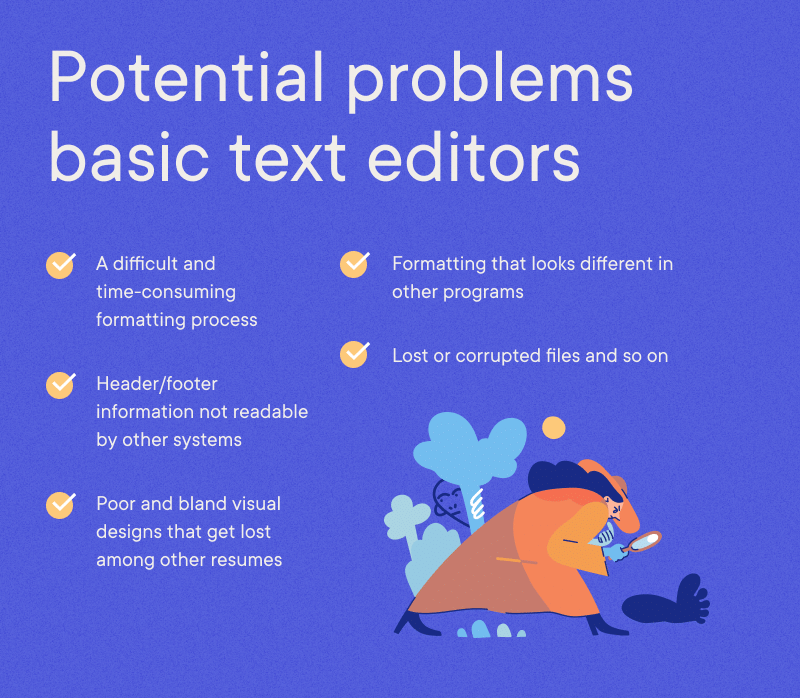
These may include:
- A difficult and time-consuming formatting process
- Header/footer information not readable by other systems
- Poor and bland visual designs that get lost among other resumes
- Formatting that looks different in other programs
- Lost or corrupted files and so on
So, what’s the solution?
The accepted standard for submitting most resumes is the PDF file format. The benefits are clear in most cases: universal formatting that doesn’t change regardless of where you view it and readability by most software systems.
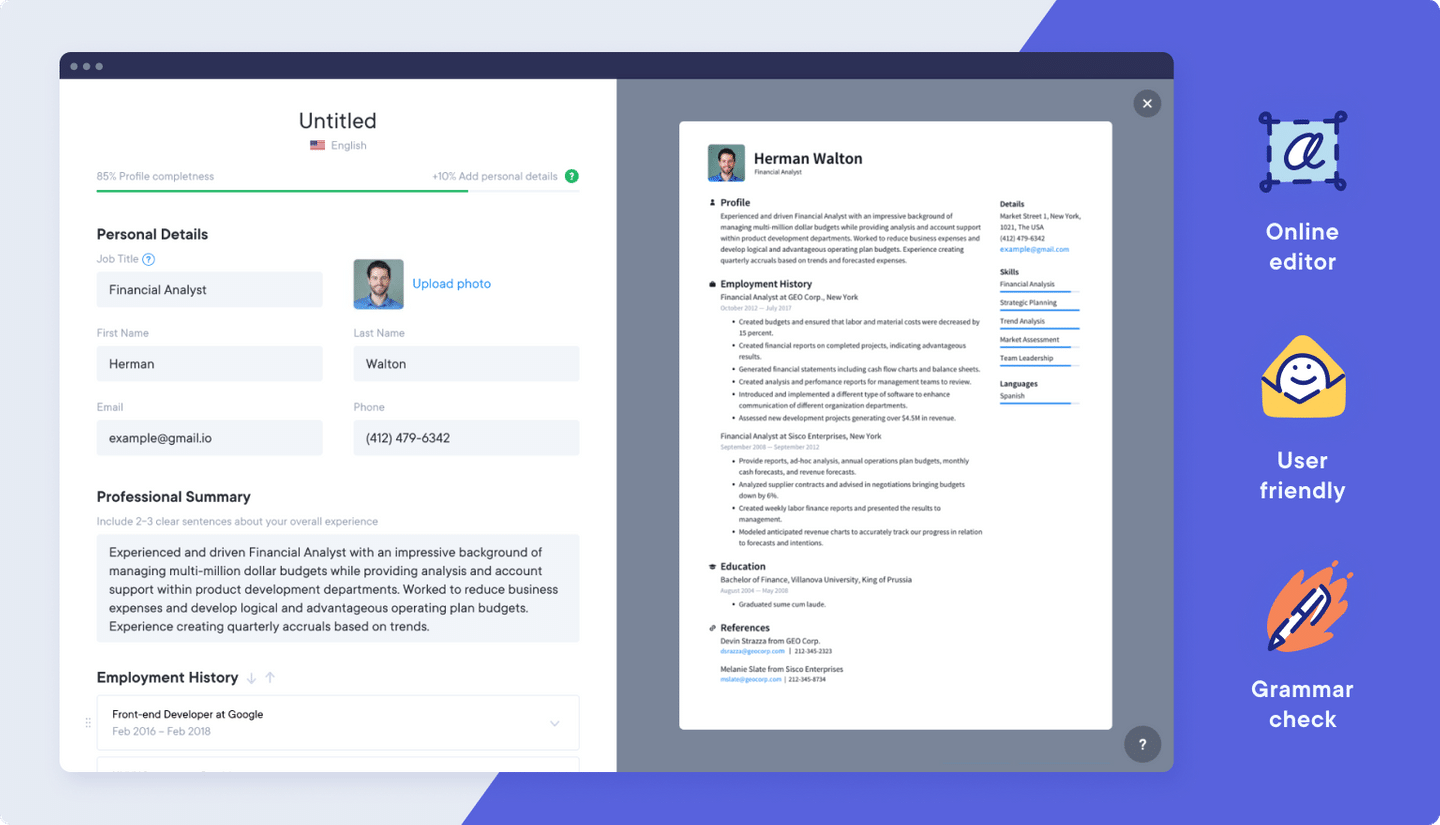
The ideal tools to produce clean, concise and beautiful resumes in PDF format are online builders. These web and/or software solutions are specifically made to be the perfect instrument for visually striking, technically functional and content-optimized resumes.
By using a service/platform that is designed specifically for resumes, you save lots of time and avoid hidden problems. With an online resume builder , what you see is what the hiring manager will see.
There are 3 common resume formats: chronological, functional, and a combination. Here's how to choose the right one for you.
What is a resume format?
The phrase “resume format” is often a confusing one, since different sources use this term to refer to different/multiple things.
In the most basic sense, a resume format is the type of structure your resume has depending on the order in which resume sections are presented, how the employment history section is written and which sections are given the most emphasis.
For example, in one type of resume format, the skills section may be overly emphasized, while in another, your work history will take center stage.
3 main types of resume formats
Luckily when it comes to choosing a resume format, your choices are already narrowed down to three main types:
- Reverse chronological
- Functional
- Combination
Each one offers unique advantages and there are no best resume templates. You may even want to create a version of your resume in each format depending on the job title, the company or even the country in which you are applying. An online resume builder can make it much easier to quickly switch around sections and go from one format to another without much fuss.
Reverse chronological format
The old standard, the reverse chronological format has probably been around nearly as long as resumes. And it’s not without good reason. A chronological format is still the best way to showcase employment history , especially in traditional industries where climbing the corporate ladder is the most commonly accepted route. All the best resume templates will focus on this logical approach.
The old standard, the reverse chronological format has probably been around nearly as long as resumes. And it’s not without good reason. A chronological format is still the best way to showcase employment history , especially in traditional industries where climbing the corporate ladder is the most commonly accepted route. All the best resume templates will focus on this logical approach.
Functional resume format
For jobs where specialized skills count for more than employment history, the functional resume can be a lifesaver. This format allows you to highlight your expertise right from the top of your resume in a section often called “Experience.” Whereas a chronological resume format shows an employer what you’ve accomplished in the past, a functional resume format is more focused on the skills and specialized knowledge you can offer right now.
Since a functional resume format is more flexible than a chronological one, it’s a great choice for a variety of job situations. Skilled tradespeople, freelancers, gig workers, students and even recent grads can all benefit from highlighting their strengths without having to categorically organize them under previous positions which may be too numerous or repetitive.
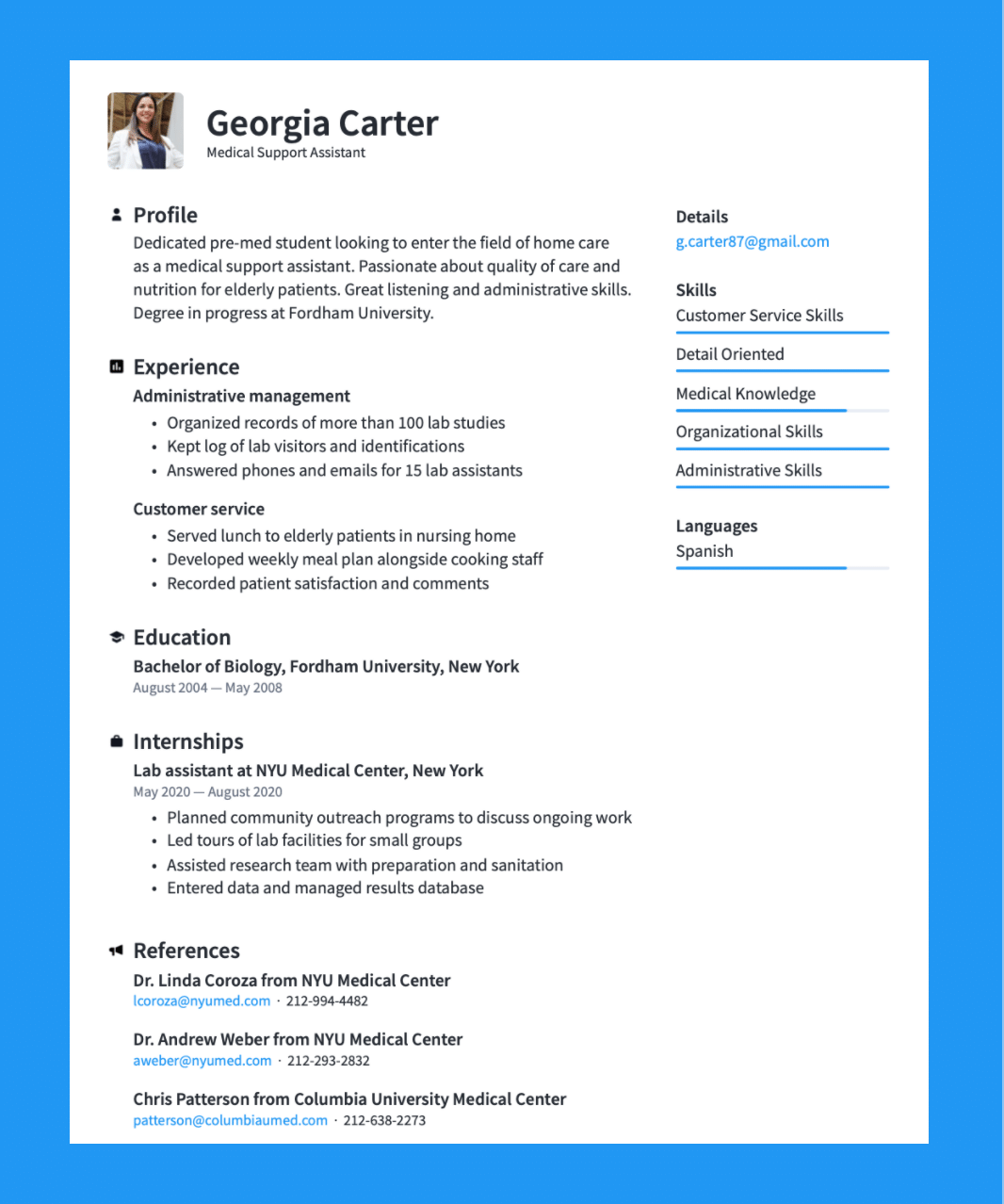
Combination resume format
A combined format, sometimes called a combination format, is exactly what it sounds like: the perfect fusion of the chronological and functional formats. The need for a combined resume format is often dictated by the candidate’s job search. For example, a freelancer looking to apply to a full time position may want to begin the resume with top skills before following up with an Employment History section to show their ability to work in environments similar to the prospective employer’s.
Many professional resume writers will write in a combination style while still calling it reverse chronological. Highlighting your key skills at the top is a genuinely smart move for many roles. The work experience section isn't so far behind and you can normally still fit the two most recent roles on page one.
The advantage of the combined resume is that it allows the job seeker to first draw the hiring manager’s attention to their strengths, while also providing the employment history information that many traditional companies still expect. For candidates whose experience best fits a functional resume but aren’t sure how well it will be received, a combined resume is the right choice.
Here's a video that can help you choose between a combination or chronological resume format.
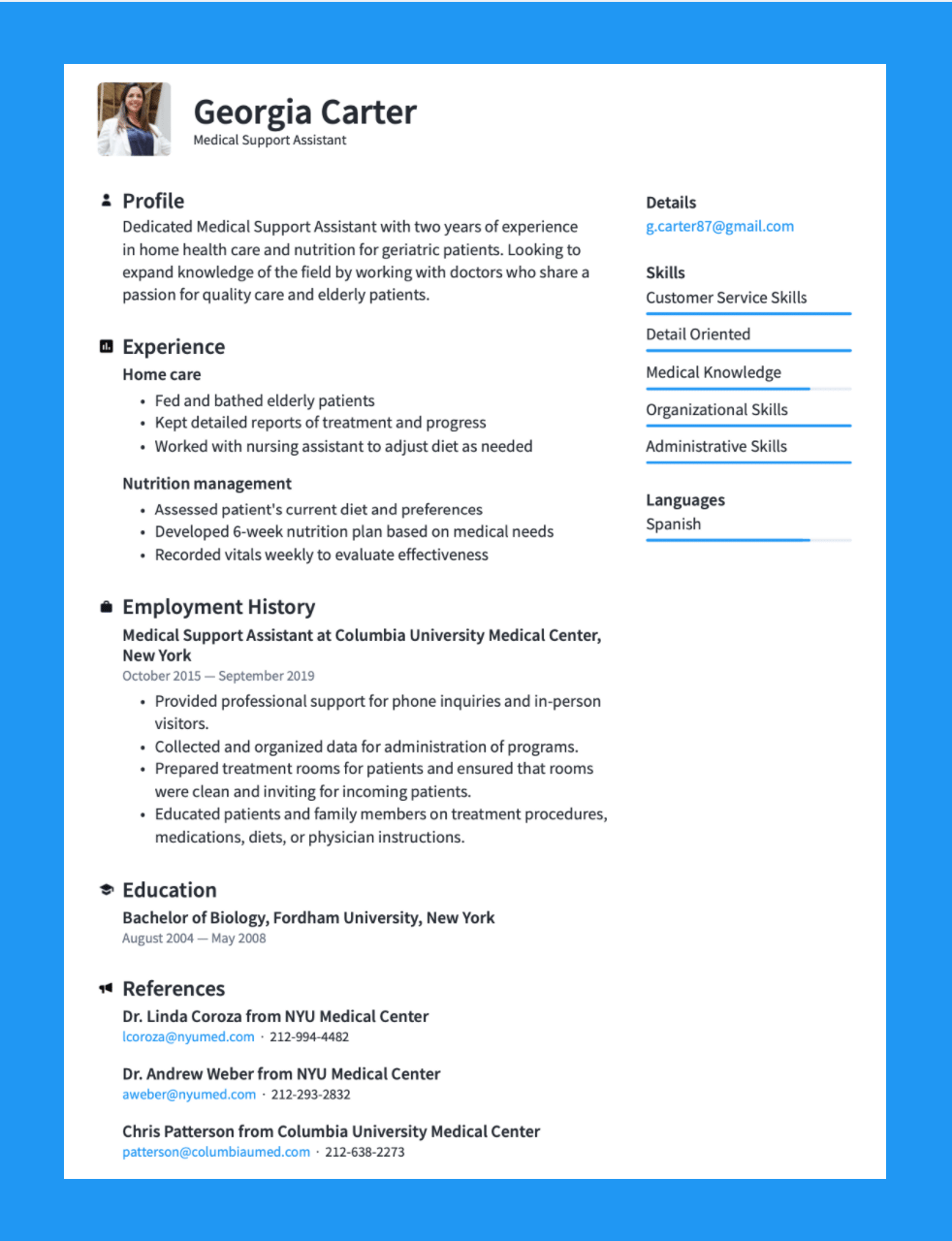
Using a chronological resume to find a job
The term chronological resume is a bit of a misnomer, as this format actually puts employment history and education in reverse chronological order. That means you list your last or current job first, and your first job last.
Likewise, when using chronological order in reverse, you list your highest educational achievement first and earlier milestones below that.
The reverse chronological resume format is the one most commonly used, as it generally showcases a candidate’s most impressive experience first. If you’re a brain surgeon looking for a new position, it wouldn’t make much sense to start off your employment history with your first job at McDonald’s.
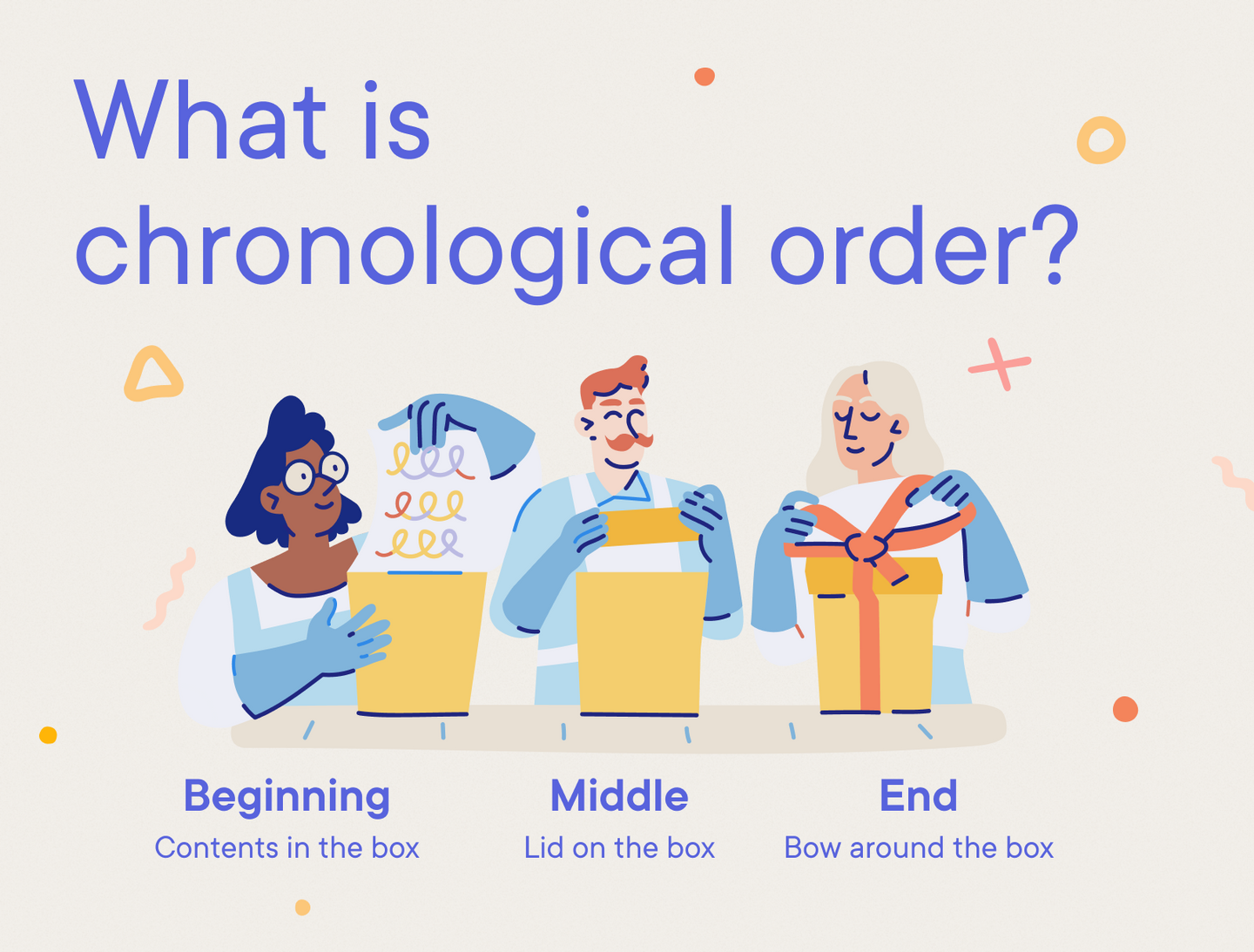
What's the difference between chronological resumes and other resume formats?
The primary alternative to the chronological/reverse chronological resume is the functional resume format , which focuses on your experience and skills rather than a time-based narrative of how you acquired them. The hybrid resume format uses a combination of these two approaches.
For example, you may be a professional accountant who is looking for an “exit strategy” to pursue your longtime passion for photography. If you’re preparing a resume to promote your experience doing wedding, event and real estate photography, it would make little sense to provide a detailed chronological list of your past jobs as an accountant. In this case, a functional resume emphasizing your photography experience would be a better choice.
Let’s dig a little deeper into the chronological resume to see if it’s the best choice for you. What this guide will cover:
- When to use a chronological resume
- Advantages and disadvantages of a chronological resume
- The format and structure of a chronological resume
- Writing the employment history and education sections
Do resumes have to be chronological?
Most resumes are chronological, but you can also use a functional resume or hybrid. It depends on your experience and what would suit best based on whether your career has been seamless (chronological) or you have embarked on a career rollercoaster (function/hybrid)

When to use a chronological resume
The chronological resume format is usually the best one to use if you have years of continuous experience in the field in which you’re seeking a job. This is especially true if you followed a more or less “normal” career path in which you progressed from an entry-level position to progressively more senior posts.
This format is usually used by people with a proven track record in their field, especially those who can demonstrate contributions they’ve made to their previous employers’ business. The emphasis is on experience, which is the main thing that employers are usually looking for in a job candidate.
There are several advantages to this resume format, including:
- It’s familiar to recruiters, so it’s easy for them to process.
- It’s easy to write, and there are lots of examples and templatesto guide you.
- It demonstrates contributions made at previous jobs, which may be similar to what what the prospective employer is looking for.
- It shows experience with other companies in your field, demonstrating your connections and familiarity with the business needs and challenges.
- It tells a story of career progression, with growing experience, responsibilities and contributions.
Every coin has two sides. There are some potential disadvantages to using a chronological resume format as well, including:
- It may reveal gaps in your employment history that could raise questions for a recruiter.
- It may demonstrate “job hopping,” or having worked many jobs for a short amount of time, making potential employers wonder how long you might last at their company.
- If you’re changing careers, a long career in one field may do little to demonstrate your qualifications to begin a new one.
If these disadvantages outweigh the advantages, you may want to consider using a functional or hybrid resume format.
Is a chronological or functional resume better?
The answer is that it depends on your experience. If you have a clear career path without lots of gaps and you have been with employers for 1 or more years, a chronological is the best option. However, if you've had a lot of temporary roles or gaps on your resume, you may want to consider a functional resume.
The structure and format of a chronological CV
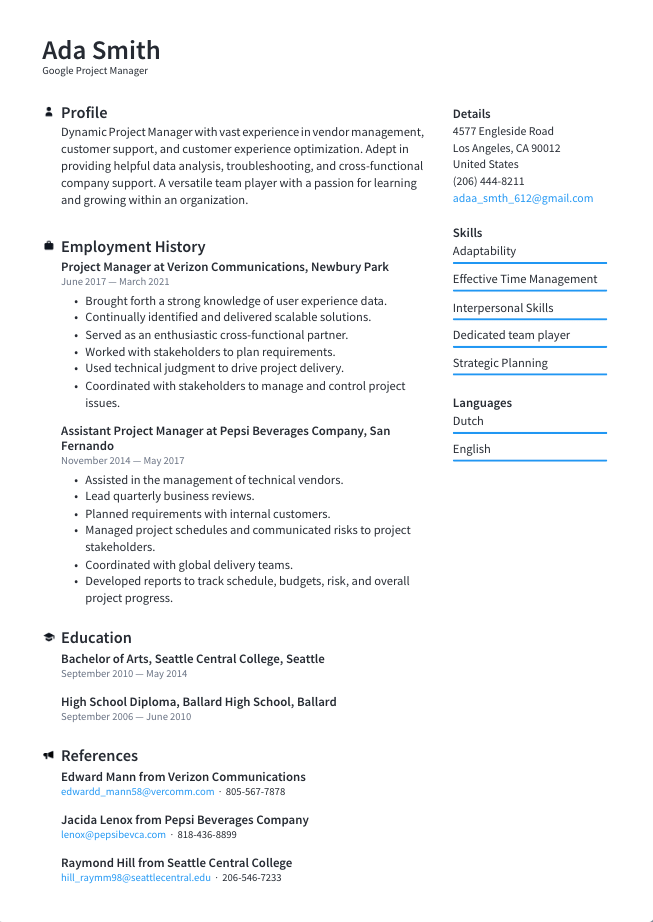
A chronological resume (or CV, as this document is known outside the U.S. and Canada) should follow this basic structure and format:
• Header: Contains your name, occupation, address, email and phone number.
• Summary/profile: Contains your name, occupation, address, email and phone number.
• Employment history:A listing of your past jobs (last job first, first job last), with bullet points on what you achieved at each one.
• Education: Your formal educational experience (highest degree first) and any certifications in your field.
• Skills: A short list of the hard and soft skills that make you good at your job.
• Optional sections: Membership in professional organizations; hobbies and interests; references
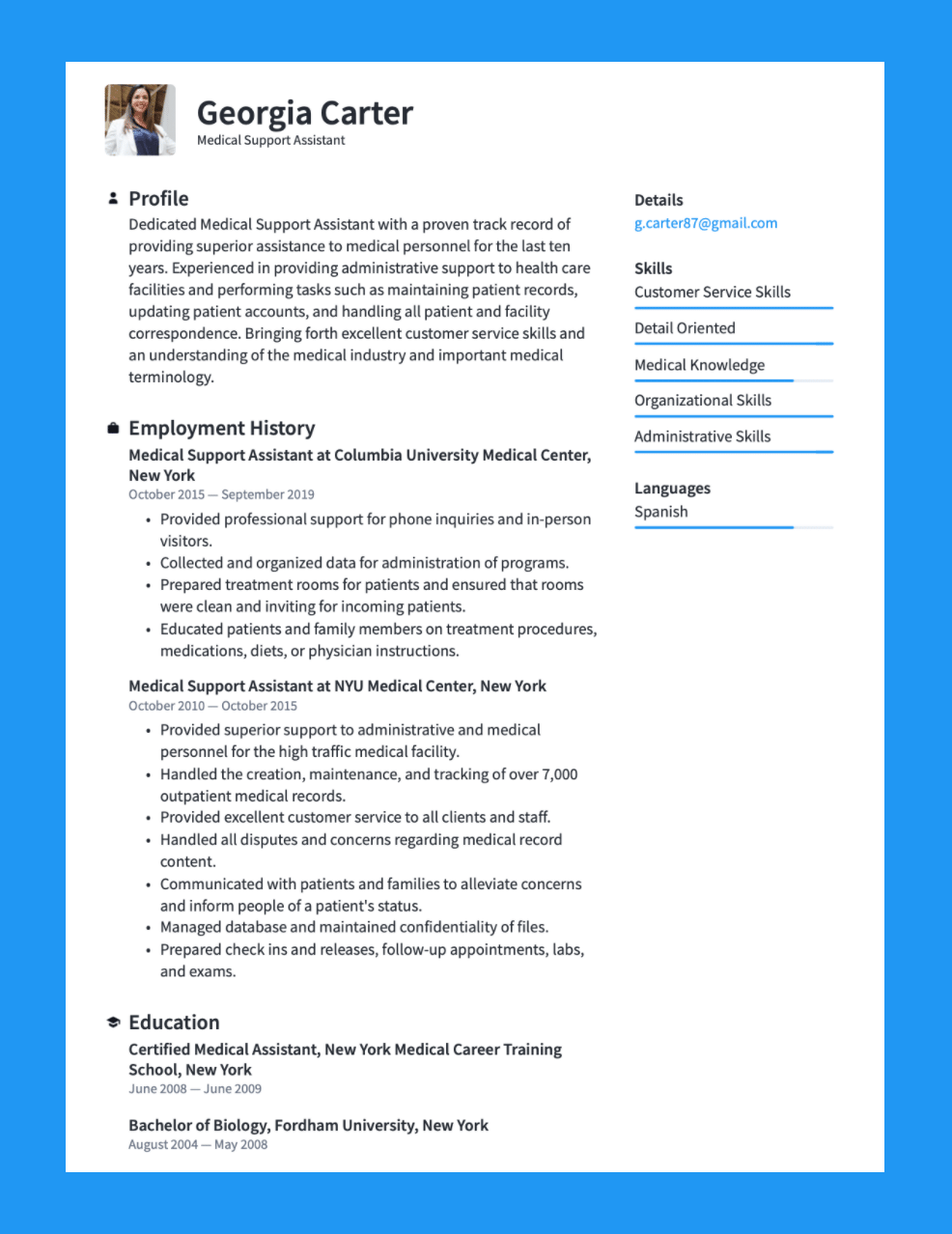
Here is how a chronological resume should look .
Choosing the right format is one of the first and most important decisions you have to make when writing a resume. This guide will discuss the nuances of the functional format and the circumstances for using it. We'll also provide you with adaptable examples and plenty of other resources to help you choose the right type of resume.
A functional resume focuses on your skills and talents. It shows the reader how you can contribute to their organizational objectives from day one. It also helps to mask any issues with your employment history which a chronological resume may expose, such as limited experience or job gaps. We will discuss the pros and cons.
This guide will help you to confirm that a functional resume is the best choice for you, by teaching you the following:
- Introduce the functional resume as an option
- Show you how to create a layout for this type of resume
- What information to include in a functional resume
- How to organize each section
Why do many recruiters hate functional resumes?
While a functional resume will be suitable for certain job seekers, as we will explore, we cannot escape the fact that recruiters dislike them. Functional resumes make it hard to understand when you accomplished specific things, there is little opportunity to understand the context of accomplishments and they automatically assume that the applicant is hiding something. If you have any career of note (3+ years) - think very carefully whether you want a recruiter to be feeling this way.
The functional resume: An introduction
The functional resume format is applicable for individuals with a great deal of education and training and/or a strong set of job-related skills. This includes new graduates or experienced workers transferring to a new industry where their skills and education will apply. It is also good for people who have worked for a limited number of organizations and whose skills are more important than the employers they have worked for.
A functional resume highlights your skills and talents and how they relate to the job you’re applying for. Often, the skills you have are the same ones described in the job posting. This type of resume is best for people working in technical or skill base professions, or who are transitioning into a new career.
My career path hasn't been smooth. Should I hide it with a functional resume?
Being open and honest about your career is the only choice. If you attempt to hide job hopping and career gaps with a functional resume, you guarantee an awkward barrage of probing questions in an interview (where you will have to tell the truth). Career gaps happen, mistakes happen and people get fired for no reason. Interviewers understand this - a bumpy career history doesn't mean that you won't do a fantastic job.
Format of a functional resume
The format of a functional resume is very specific. It is structured to enable recruiters to quickly determine your qualifications for the job and to encourage them to read the complete resume to learn more about you. An easy way to create your resume is to select a functional resume template which you can find online and simply insert your details into the appropriate sections, following the prompts provided by the functional resume template. However, you still need to know what the structure of a functional resume looks like.
The basic structure for a functional resume is:
- Name and contact information (email, phone and possibly the location, but never an address)
- Title – This should match the job title you are applying for
- Summary of applicable skills and any experience relevant to those listed in the job posting.
- Hard Skills – The emphasis is here. These are the skills directly related to the job
- Additional Skills – Soft skills which complement the job
- Education – Formal, vocational and subsequent training in specific skills (note – this may precede the Skills section if you are a recent graduate or have received recent training which would qualify you for the position)
- Experience – Brief listing of employers, dates, and title
- Industry related certifications
- Industry organizations
- Volunteer experience
Career change is a valid reason for a functional resume format.
Having said that recruiters don't like functional resumes, when you are changing careers and wish to emphasize that you have the necessary skills to do your new job, a spotlight on functional skills and competencies is exactly what you need.
Sections to include on your functional resume
The basic content you include in your resume is similar for any resume format you choose to use. However, how it is organized and how much detail you provide for each section differs depending on the type of resume you are writing. Here are the content and organization recommendations for the functional resume.
Contact information
The resume starts with your contact information. This will allow the employer to reach out to you to invite you to an interview, which is the purpose of a resume. Your contact details should include:
- Name
- Phone number
- e-mail address
- LinkedIn profile URL
Each of these items could be at the top of each page of the resume so the employer will know whose resume they are reading. Your name should be slightly larger than your contact information. Your email address and LinkedIn URL can contain links which the employer can click on. Anything you can do to make it easier for the employer will help you land the interview.
What is a resume personal statement?
A resume personal statement expresses who you are, where you’ve been, and sometimes where you plan to go next right at the top of your resume.
The resume personal statement hooks in a reader, influencing them to read more. So, how do you write a resume personal statement that is both natural and grabs an employer’s attention? Offer them a brief insight into who you are and why you would be a fantastic hire. So what do you write in a personal statement for a job?
This guide will cover:
- The basic formatting of a personal statement: How to tailor your personal statement to give you a competitive advantage
- Personal statement examples you should (and shouldn’t) use
- Practical steps for getting started on your resume personal statement
The personal statement format
The personal statement is a short paragraph that sits right below your contact information at the top of a resume. It sums up your experience, goals and skills with confidence. Think of your resume’s personal statement like an extended tagline for your career. A resume personal statement should include:
- Between 50 and 200 words in 3 - 4 sentences
- Your title or function, for example “Junior developer” or “Passionate hospitality manager”
- An opening hook
- Soft skills and hard skills
- Impressive facts and stats
- Your short and/or long-term goals
- Job-specific slant for the position you’re applying to
This may seem like a lot to cram into 200 words but perfecting your elevator pitch shows that you have a firm grasp of why your experience, goals, and skills make you the perfect fit for the job.
This brief introduction is only a short piece of text, it is not disruptive and in many cases even serves as a welcome addition to what is otherwise a dry and impersonal document. It should be clear to you by now how we feel about the personal statement: Include it, especially because it allows you that bit of creativity that may make all the difference.
How do I start my personal statement? How do you not start a personal statement?
Even with a personal statement of 3-4 lines, sometimes the first sentence is the hardest. Even the first few words can have a disproportionate effect on how your personal statement is viewed. Your starting "hook" should make your fit with the role clear and specific. Use an example that is as unique to you as possible - you have to make your future employer sit up and pay attention. The first word of your personal statement should never be "I" - a great resume explores the potential of a common partnership and should not be a uni-directional monologue.
Align your resume’s personal statement with the job description
The hiring manager delicately chose every word in their job description. Gather clues from its tone, which skills they highlight, and any hints that point toward their dream employee. One of the top resume tips from HR managers is to include relevant keywords specific to the job posting itself as well as the actual wording of the job title.
What would this job description look like in 3 - 4 sentences? What keywords, skills, and tone would the job description have?
While still sticking to the facts about who you are and your experiences, your resume personal statement should highlight as many similarities with the job description as possible. When the hiring manager reads the first few sentences in your resume, they feel like you are exactly the person they were describing when they wrote the job description.
Position of the personal statement
Recruiters still prefer to see a candidate's personal details at the top (or running along a column on either side) of the resumes that cross their desk. This allows them to quickly search through the resumes that Applicant Tracking Systems have sorted into their virtual “yes” pile. You do not want your (relatively modern) personal statement to get in the way of this tradition.
The best place to put your statement is after your personal details (if they are at the top) and before your employment history section. Remember that the length of your resume is important. If you have already been very selective and cannot possibly leave out any more information and if adding your personal statement means your resume spills over onto a third page, you may consider not including your statement for the position in question. This ensures you comply with the unwritten rule that a resume should not be longer than two pages.
What is a good personal statement length?
200 words is the maximum suggested length, but if you go with one powerful sentence that you want the hiring manager to remember for the rest of the interview process, then why not? Less is more, but you have to be confident in your application to go with this option.
Writing the work experience section
Writing the resume work experience section is one of the most influential and often trickiest resume sections to get right.
The work experience/job history on a resume is where past job descriptions and professional experiences give credibility to an application or interview. All the other information and sections on a resume, from hobbies to the personal statement , frame the list of relevant work experience over the last 10 - 15 years. So, how do I describe my work experience on a resume?
This guide will show you everything you need to know about including work experience on a resume, including:
- Why the work experience in cv matters
- What to include (and not include) in work experience on a resume
- The best format to follow for describing your work history
- Examples of work experience in cv across industries
- Practical tips for resume work experience
- How to list your current job and previous positions
The five-word rule. Think about five words that would be sum up your career. How would you describe your experience? Those five words should then come across incredibly strongly in the work experience on a resume. A hiring manager is not going to remember the sentences that you write, but if they stop reading with those five words (or more) in their minds, your resume will have done its job.
Why is work experience on your resume so important?
Before we jump in to the ins and outs of writing work experience on a resume, here is why it matters. A hiring manager or employer looks at a resume to answer one question:
Does this person’s work experience qualify them for this job?
The work experience section of your resume is the foundation that either qualifies you or disqualifies you for an interview or the next step in the hiring process. This resume section uses the last 10 - 15 years of relevant career history to tell a prospective employer whether you have the work experience in your cv that will fit the requirements of the role. The work experience section gives credibility to your application and should compliment every other aspect of your application materials (other sections in the resume, cover letter, portfolio, etc).
How do I add experience to my resume: What to include
In most cases, choosing which jobs to include on your resume should depend on your work history and the type of job you’re applying for. In general, work in a backward chronological order (in a resume format often known as reverse chronological format ) starting with your most recent position at the top of the page and include the last 10-15 years of employment history. The backward chronological order works best for most job seekers.
If you have a scattered work history, don’t stress. Job hopping is both more common and more widely accepted today, especially among the younger workforce. Including short part-time stints and side projects is good if those professional experiences directly relate to the job or feature skills that overlap with the position. Be prepared to answer questions about your career choices while considering work experience in cv, have a confident answer about your career path, and be forthcoming about the level of commitment you’re looking for. Once you’ve chosen the positions, let’s dive into the specific bullet points about work experience in a cv. Each one should include:
- Results-focused facts: The hiring manager already knows the basics. These bullet points should focus on how you specifically managed the position with innovation.
- Action Verbs: Strong action verbshook in the reader. Negotiated! Pioneered! Transformed! This also keeps you away from falling down the adjective rabbit hole.
- Quantitative information:Numbers stand out to a hiring manager. They are specific and tangible. You grew a client’s reader base by 300% or managed 200 silent auction items. Let your.accomplishmentsshine!
- On-Site Training: Weave skills and certifications gained on the job. This shows initiative and otherwise overlooked abilities.
- Awards and honors: If you were called out on the job for great work, go ahead and brag. Your work experience resume examples should be designed to impress.
How do I write a student CV?
A student CV for a first job should contain full details on your education (as that will testify to your ability to focus and achieve) and ideally also contain details on any student jobs or volunteer work that you have done while you were studying. It doesn't matter how menial this work was, the most important thing is that you understand the responsibility of doing a paid day's work.
Work experience on a resume: what to avoid
Always assume that your reader — in this case, the hiring manager — doesn’t need anything explained. You also have very little room to ramble on your resume.
Free up some space by not including:
- What the organization does: your resume is about you. The hiring manager doesn’t need to hear about the company.
- The basic requirements of your position: this is implied in your job title and will shine through your result-focused bullet points.
- Filler words: For the most part, save space by cutting out words like “I” and “the.”
- Anything irrelevant: If you have smaller responsibilities in a position that do not relate to the new job, leave them out. Every bullet point and every word takes up precious real estate on your resume - make them count.
When you are making your case for a new job, it is your blend of resume skills that will show a hiring manager whether you are qualified for the role.
These resume skills might be listed in a specific section, described within your work experience , or even subtly implied in the summary, and they are an essential ingredient in your job search story. They are the foundation of your achievements.
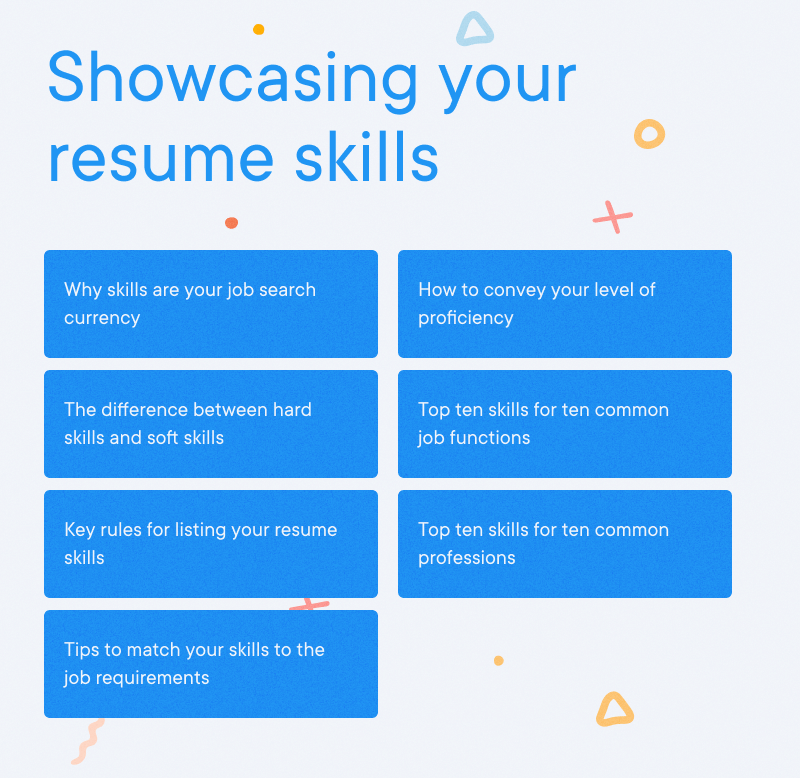
The thing is, once you have listed a skill in your resume you have to be able to back it up with the career story that lies behind it. Resume skills are the strengths , talents, traits and wisdom that you have acquired throughout your education and career. The skills are your badges of honour, but it is the achievements that those skills support that are the hero content of any job search. This guide will cover how to go about showcasing your resume skills to the best effect, including:s
- Why skills are your job search currency
- The difference between hard skills and soft skills
- How do you list special skills on a resume?
- Tips to match your skills to the job requirements
- How to convey your level of proficiency
- Top ten skills for ten common job functions
- Top ten skills for ten common professions
Do resumes have to be chronological?
It is of utmost importance that your resume is easy to read, so if you leave out some of your more obscure skills, you will still have the chance to mention them during an interview. You never quite know what the hiring manager is looking for, so describing a particularly specific skill when you are not sure whether it is required is a little risky. Make sure that the key skills for the role are all included. Then you can sprinkle some of the minor skill fairy dust.
Why skills are your job search currency
When you sit down to consider your next career move, you could do a lot worse than sitting down and listing all the things that you are good at. Then have a think about how these skills have contributed to your achievements and you will be able to sense how you will go about convincing your next boss to give you a job.
Your resume skills are your job search currency because they show a hiring manager whether you have what it takes to do a job. If you can share examples of your skills in action, they are the ultimate objective measure of your ability. But what counts as a special talent or skill? Well, put simply, any ability that helps you to do your job better than anyone else.
The difference between hard and soft skills
Hard (or technical) resume skills are all the practical, industry-specific tools and know-how needed for a job. Hard skills are quantifiable and usually learned in school, on the job, or training. Hard resume skills can usually be tested and are sometimes verified during the hiring process.
A modern trend we see across the millions of resumes created with Resume.io is that more job seekers use hard skills to optimize the keywords on their resume. This strategy is an especially important step for candidates applying to larger companies who are likely to use Applicant Tracking Software (an ATS) to automatically filter and score resumes based on a list of keywords in the job description.
Soft resume skills are usually aspects of your personality, work style, or effectiveness that are harder to measure or quantify. Soft skills are especially important for positions of leadership or positions where you are interacting with customers. When you have two candidates of similar backgrounds and professional qualities, it is often the soft skills that can be the deciding factor in who is hired.
Once hiring managers assess your hard skills to know you can get the job done, they look to your soft skills to know if you can get the job done well. For many modern offices and creative start-ups, a company culture fit could be the edge over someone with the same hard skills. Soft skills speak louder in some situations.
Many recent studies have demonstrated the importance of soft skills in today’s job market. According to LinkedIn’s 2019 Global Talent Trends report, 92 percent of hiring managers agree that strong soft skills are increasingly important. A study reported by SHRM, an organization for HR professionals, found that almost half of executives thought a lack of soft skills was the biggest proficiency gap in the U.S. workforce.
Profession-specific examples of hard and soft skills
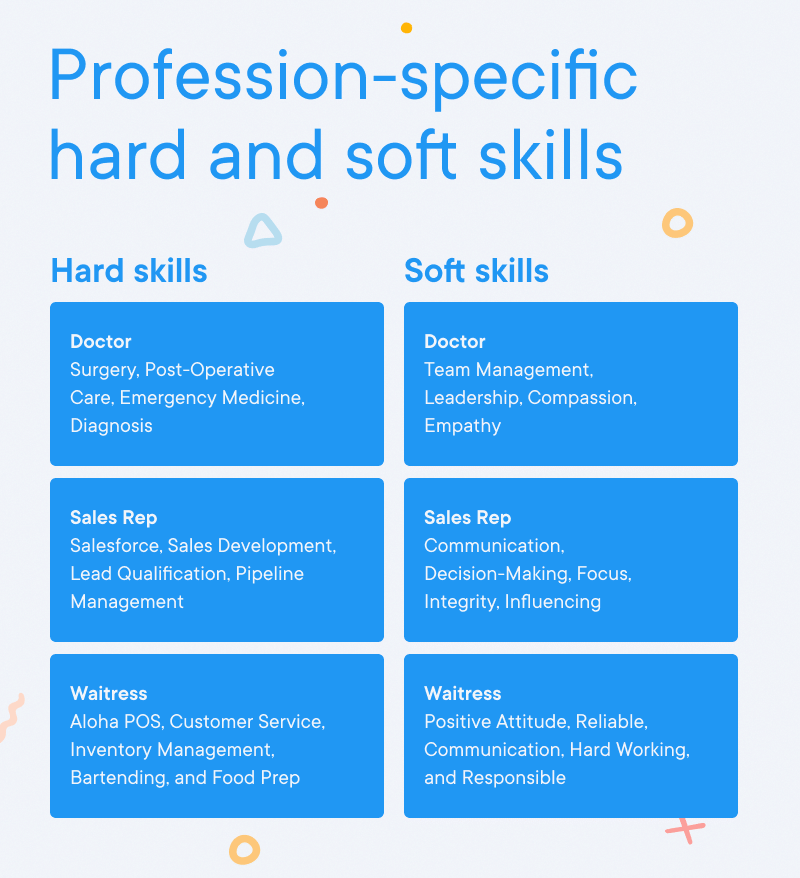
Hard skills ( Doctor ): Surgery, Post-Operative Care, Emergency Medicine, Diagnosis.
Soft skills (Doctor): Team Management, Leadership, Compassion, Empathy.
Hard skills (Sales Rep): Salesforce, Sales Development, Lead Qualification, Pipeline Management.
Soft skills ( Sales Rep ): Communication, Decision-Making, Focus, Integrity, Influencing.
Hard skills (Waitress): Aloha POS, Customer Service , Inventory Management, Bartending, and Food Prep.
Soft skills ( Waitress ):Positive Attitude, Reliable, Communication, Hard Working, and Responsible.
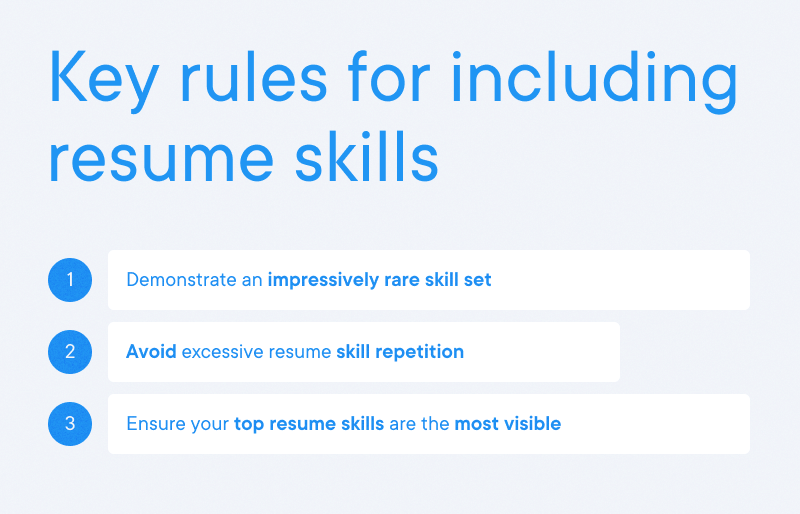
Key rules for including resume skills
How do you describe skills on a resume? There is much more to describing your skills on your resume than a few afterthoughts in the skills section. Rare skills may need some explanation, certain skills may crop up over and over again and how do you ensure that your very top skills are most visible?
1. Demonstrate an impressively rare skill set
One of the best ways to send a hiring manager to sleep is to include the same resume skills as every other candidate. When they read the words communication skills for the tenth time, they will mentally pigeon-hole you with all the rest of the average candidates.
If they think that you are average because you have included the same average skills as everyone else, it will be incredibly hard to shift that perception if you are lucky enough to be invited to an interview.
2. Avoid excessive resume skill repetition
When you have multiple places to share your skills, it is easy to think that repetition is a powerful way of getting your message across. Believe me, it isn’t. Even if you use different words to describe the same resume skill, you need to realize that your resume real estate is far too valuable to be doing this.
In order to come across as a rounded professional, you should seek to highlight as many different skills as possible in the skills section, employment history and summary. By all means, repeat a couple of the really core resume skills, but variety is definitely your friend.
The more skills that a hiring manager can read on a resume, the more interesting the potential interview with you might prove.
3. Ensure your top resume skills are the most visible
In the table below you can find the three places to list your resume skills. There are different ways to describe your skill set to a potential employer, but if there are skills that you want to shout about from the rooftops, you should absolutely put them (or describe them) in your summary or skills section.
You might think that a potential employer might read every detail of your work experience, but that may not be the case for many reasons. You can’t afford for critical skills to be lost in your general work experience, so put them at the top of your resume in the summary or in the specific skills section (where they are most visible but have the least context).
Learn about best practices for listing education on your resume, plus tips for special circumstances.
When contemplating how to list education on a resume, you need to realize that it is an essential component of your job search story. In today’s knowledge-hungry world, it’s common to have diverse educational experiences that could include things like high school, college, graduate school, online certificates, bootcamps, licenses, and beyond.
If you are curious and ambitious, education carries on long after your graduation day.
This guide will teach you:
- The basics of how to add education on resume
- Special circumstances such as incomplete or in-progress programs, certifications, courses, and more
- How longevity of career affects the type of education that you should list
- What about writing a resume with no education included?
- How you list different kinds of education?
- Expert tips and examples of how to put education on your resume
Let’s start with basics of how to list education on resume
In terms of a layout, a resume's education section includes:
- Name of the institution
- Degree
- School location
- Date of graduation
- GPA (only when over 3.0)
When wondering how to list education on resume:
- Start with your highest qualification and work your way back in reverse-chronological order
- Only include high school if you did not attend college, attended a prestigious private academy or recently graduated.
- The placement of the education section of your resume depends on your graduation date, if you’re a recent graduate education on your resume is more important and should be added closer to the top of your resume.
Do employers verify education?
You might think that no employer has time to check references or verify education, but no matter what the level of hire, it is actually incredibly easy to do a basic check. A quick 5-minute phone call will suffice and every university will have easy access to previous graduate results. While this isn't industry standard, if there is any hint at all that you are bending the truth with your educational claims, it is not hard to verify what you have listed. It is a sackable offence if you lie in such a way on your resume.
How to put education on a resume in unique educational situations?
Unfinished programs - if you started a degree or some other type of program but didn’t finish, only put it if the experience gained is relevant to the position. For example, if you’re applying for a sales position and you have 40 credits toward a Geology degree, it’s probably not worth mentioning unless it was at a prestigious institution.
How do you add your education on your resume if you are applying to work in a museum, with an unfinished art history program? Include it as you can always discuss the circumstances at interview. Keep in mind anything you add, including education on your resume, is fair game for discussion.
If you’re in high school and you’re creating a resume for a part-time job , first good for you - great job, and second you’re likely not getting this job because of your work experience so use this section to highlight the type of student you are, your work ethic, and passions.
Certifications - if you started a degree or some other type of program but didn’t finish, only put it if the experience gained is relevant to the position. For example, if you’re applying for a sales position and you have 40 credits toward a Geology degree, it’s probably not worth mentioning unless it was at a prestigious institution.
Bootcamps & Workshops - recent participation in education outside an academic institution like a code camp, yoga workshop, healthcare certification, or trade school should be considered when wondering how to list education on a resume.
Keep any descriptions short and to the point, or skip elaborating altogether. Adding a hyperlink to the program or organization can help give context if a program is uncommon
Internships - if you were an intern, even while in school, instead of adding the internship under education on your resume, consider adding these details under work experience or even a dedicated Internships section. The education section is usually glanced over on a quick skim to cover the requirements. The bullet descriptions outlining your internship experience are a lot more likely to be read in the work history or a custom section closer to the top of your resume.
What is your highest education level?
Your most recent educational qualification may not have been your "highest" level, so put your most significant education first in the list. It does not matter if it is not the most recent. Make sure you list the education on your resume that is most relevant and impressive. This includes industry certifications. A recent industry qualification is more relevant than a degree from a decade ago.
Tips around how to include your education
Even though content will differ across people, industries, experience levels, there are a few general rules of thumb when buttoning down how to include your education on your resume.
Always be honest. No matter what, never stretch the truth about education on your resume. It’s a small world, and it’s extremely easy for someone to verify your education when necessary.
If formal education isn’t the focus of your resume achievements, there are better ways than lying to demonstrate how education (and more importantly learning!) is woven into your professional life. If you have no education to add, beef up the special skills section to focus on soft and hard skills learned outside of the classroom.
Don’t lose confidence about skipping education on your resume all together. If you are qualified for the job, it should come across in your experience, skills, and the overall presentation of your resume. Education only plays a supporting actor role. It is your work experience and potential for career growth that is of interest.
Keep it clean and consistent. We’ll jump into this a bit more below. When wondering how to put education on your resume, keep it short and sweet and pay close attention to the format and consistency. The right resume template can guide toward a clean design or you can use the examples below for inspiration.
Tailor your info. Always customize your resume for each job application — from the hobbies section to work description to the education on your resume. Though college degrees always make the cut, you don’t want to list that you’re trained as a chef if you’re applying for an office job. If any kind of education is not relevant (apart from your main degree), consider cutting it from the resume. Every line in a resume has to earn its spot.
Note honors and awards. Education on a resume rarely includes long bullet points or descriptions like work experience, but you can include important honors societies, high GPAs, notable mentors, scholarships, or awards in this section. The early-career resume will likely have more - senior professionals will have more important recent achievements that they will want to highlight.
Relevant professional development. Certain industries, such as education and the arts, put a lot of weight on who you’ve studied with and on gaining specific training. If you have a large number of classes and workshops, pick out those that could catch the hiring manager’s eye for that specific job.
If you have a high level of academic experiences such as publications, lectures, and studies it’s best to dedicate each of these their own category or section rather than trying to fit everything inside the section for education on your resume.
Listing education where it counts.You’ve just graduated from college and are hitting the intern/job scene for the very first time. In this case, how to include education on a resume is the most critical question. We recommend to list the education section above the work experience section. Don’t stress — hiring managers are thrilled to get people fresh out of college. In this scenario, list it right at the top below your personal statement . Hopefully, you then have some interning or part-time work experience to round off the resume.
In all other cases, write the education section at the bottom of your resume, often below work experience and special skills .
- Be 100% factual with timings
- Only include relevant education
- Put education at the end of the resume
- Gloss over any time out
- Pad your resume with "courses"
- Focus on education instead of work experience
Writing a resume with no education?
Listen, you might think that you do not have an education because you did not attend college or university, but even if you did not finish high school there are many roles that are looking for other aspects of life learning than grades and certifications. Adding "education" on your resume might not be as hard as you think:
- List incomplete educational qualifications and even mediocre high school results
- What online learning have you been able to take on board?
- What lessons have you learned in your non-working life that might help?
Education comes at you every minute of every day. If you have not been a hit in the classroom, think hard about what skills you will need on the job and where you may have picked up those skills before. Don't be embarrassed - it won't seem desperate and you are simply demonstrating creativity. It will give you an advantage over those (many) people who leave the education section empty.
Take a good look at the sorts of jobs that you are applying to. More of them than you think will be open to employing someone who doesn't have a stellar education but does have the right attitude. If they do not demand certain educational qualifications in the job description, then you are likely to have some wiggle room.
Does LinkedIn confirm education?
It is not out of the question that the LinkedIn algorithm may possess a capability to verify educational claims at some future point, but currently there is no such capability. However, as with anything online, taking a screenshot is incredibly easy to do, so be careful with what changes you make. You never know who might be watching.
Should you put PhD or MBA after your name on LinkedIn?
This is a tough one. If the job that you are applying for places a large emphasis on academia, then certainly consider adding PhD after your title. MBA is a far more common qualification and many people consider it pretentious. By all means, add it in your LinkedIn profile and talk about it prominently in your summary, but including it in your title hints at a certain arrogance.
Some might consider that listing hobbies on your resume is unprofessional, but if those hobbies are genuine and contribute to the human element of your application, then they can be a potent job search weapon.
Having said that, don't go overboard. Carelessly listing hobbies in resume takes up valuable space and could put a hiring manager off, rather than intriguing them. They have to be relevant for the role.
What this article will cover:
- How (and when) to list hobbies in resume sections
- Choosing attractive hobbies that overlap with your skillset
- How to align your hobbies section with a particular job or company
- Examples of hobbies you should (and shouldn’t) include on your resume
Should you add hobbies to a resume?
There are many aspects of a resume that are compulsory, but the hobbies section is not one of them. The blog will explore the somewhat complicated issues of the matter, but the bottom line is that you should only include your hobbies if they are somehow relevant for the role.
How and when to list hobbies on your resume
How and when to list hobbies in a resume comes down to thinking like a hiring manager.
Employers seek candidates who have soft skills — like attention to detail, willingness to take on new challenges, communicating well with a team — in addition to specific hands-on experience or training.
If your leisure activities indirectly check these boxes, they could have a place on your resume. Hobbies in resume can also paint a picture of your personality and energy, giving you that precious edge above the rest of the resume pile.
Your resume is your ticket to an in-person interview. It should reflect who you are and why you’re the person to come chat about the open role. Check out these tips for listing hobbies in resume in a way that makes you sound like someone an employer would want to have on its team.
Here is a step-by-step approach to listing hobbies:
- Customize your resume with hobbies and skills that relate to the position
- Write in a compact list similar to the skills section
- Vary your hobbies to show balance but don’t overshare
- Avoid listing hobbies that are too personal or politically polarizing
- List hobbies on your resume toward the bottom
- List 2-3 hobbies at most
Is it good to mention hobbies in a resume? Yes, for sure, if you feel like it.
How do you represent hobbies on a resume?
Some may choose to simply put a list of 2-3 hobbies on one line of text, but if you have more to say for each hobby (and it may be beneficial to do so), then you can write something like this:
- Chess - won state championship three years in a row from 2011-2014
- Sailing - led a team that sailed non-stop to Hawaii and raised $90k for charity
- Programming - helped create a number of websites for various youth sports clubs
How to choose attractive hobbies that overlap with your skillset
The best hobbies in a resume are those that shine a light on your best traits while staying honest and relevant. Each hobby should reflect skills that could come in handy on the job. Start by understanding the soft skills woven throughout the job posting. Examples might include:
- Focus under pressure - downhill skiing, yoga, darts,
- Ability to meet tight deadlines - baking, computer games, crosswords
- Delegating tasks to a team - paintball, football, youth sports
- Budget and finance - travel, volunteering, antique collecting
Downhill skiing suggests focus under pressure, for example, while team sports and volunteer work highlight your strengths at teamwork. If you can’t link your hobby to a conversation that may arise in an interview — such as your button-collecting enthusiasm — leave it off.
Note: There’s always the chance that this list may spark a conversation during your interview. If your interviewer also loves downhill skiing, you’ll want to be able to hold your own in a conversation. Only choose hobbies in a resume that you’re truly passionate about. Hobbies are optional, so if you don't have a genuine or relevant hobby, you're better off skipping hobbies in resume.
How many hobbies should you put on a resume?
Just because you list one hobby doesn't mean that you have to add a couple more to make yourself look more rounded. There is always a risk that your future employer asks about the one that you are less interested in, and then you are in trouble. If you only have one main hobby (and that is one more than many of us), simply share a little bit more detail about it.
Where do you list your hobbies?
Hobbies in a resume could give you an edge over the other candidates in the pile. At the same time, your work history and education take precedence over your activities outside the office. Place your hobbies toward the end of your resume or on a sidebar that includes extra info, depending on the resume template you use.
List hobbies on your resume in a dedicated section with bullet points only if your resume is light on relevant experience. Previous work experience, even if it’s outside your career path, as well as internships and education, will carry more weight than hobbies.
Keep your bullet points clean and succinct, while including interesting information that directly reflects how it relates to you are as a person and an employee.
If your hobbies include things like volunteer work or a side gig, consider incorporating those experiences in a “Volunteering” section or within your work experience , as they’re likely to get more attention there than in a hobbies section.
Examples of hobbies in resume that impress the most
Volunteering / board membership.Specificity is key when listing the experience on your resume — but volunteering in general can give you a leg up. A recent study found that 82% of hiring managers prefer applicants with volunteer experience. It speaks to your dedication toward a team, community and reaching long-term goals for the greater good.
Photography. Photographers use both the left and right sides of their brain, composing creatively balanced images while understanding the intricate workings of a camera. Include photography under hobbies only if it’s a personal passion. If photography and training is part of your work experience or the job requirements, then you should elaborate more on photography in the work experience section.
Team sports. Dedication to team sports shows strong communication skills, an ability to work well under pressure, teamwork ability, and a focus on work-life balance. Business Insider reported that members of team sports teams tend to thrive in corporate offices. If you are involved in several sports teams throughout the year, try to find a way to summarize the activity in a few words without oversharing.
Writing and blogging. Blogging or writing within your industry is an excellent way to demonstrate your writing, editing and marketing skills via hobbies on your resume. Maintaining a well-researched and proofread blog proves critical thinking, connection to the industry and self-driven career actions.
It’s not essential to go into significant detail about any of your hobbies unless you have something really amazing to share. For example, “Running marathons” is impressive enough, but ”Have run 100 marathons” is much more so. You could mention “Chess” if you’re a weekend patzer, but if you’re an “International Chess Master,” you might want to mention it.
It used to be considered essential to include references on a resume — back when your dad thought a polyester leisure suit with a 3-inch-wide tie was the height of fashion. But times change, and today a resume that includes references is considered old-fashioned and undesirable — in all but a few limited circumstances.
What happened? Did it suddenly become irrelevant if a job seeker had former employers who could vouch for her amazing talents? Did new employers lose interest in hearing from college professors who affirmed that this new grad was the most promising student they ever had?
We’ll get into the reasons in a bit. But first, just so you know we’re not crazy, allow us to quote from the first five responses we got to the Google search “Should I include references on a resume?”
- “Job references should never be included on a resume.”
- “[I]t is a best practice to leave references off your resume.”
- “Unless specifically requested, references do not belong on a resume. It is almost never a good idea to include them….”
- “As a rule of thumb, you don’t need to include references in your resume.”
- “Do not put ‘Reference available upon request’, or the names and contact points of the references themselves.”
And those were just the first five hits!
If you prefer to get your career advice in a video, check out Career Coaching’s “Should You Include References on Your Resume?” We would quibble with this career coach on whether a resume should be two pages instead of one, but otherwise his advice lines up with ours 100%.
This article will explore the whys and wherefores of the now-dead references list on modern resumes — and the very few exceptions where they can be included. Buckle up, references fans, because it’s going to be a rough ride!
Why are references on a resume no longer used?
Sort of like video killed the radio star, we can thank the internet for killing the idea of references on a resume. The short answer is: references on a resume are usually sensitive information and should not be widely distributed due to privacy concerns. There’s also the idea of digital etiquette, which dictates you shouldn’t mention people willy-nilly, opening them up to unexpected calls and messages.
Before the 1990s, when you couldn’t send mail without licking a stamp, resumes were relatively private documents that were printed on paper, enclosed in an envelope and dropped in a mailbox. Sure, a resume might be passed around an office, hand to hand, but this didn’t make the references’ names, addresses or phone numbers accessible to millions.
That all changed with the electronic revolution, which turned resumes into digital documents that actually could be accessible to millions. Today you can (and probably should) post your resume on LinkedIn or any number of other totally public job-search websites. So do you think your old boss would be thrilled to know that you’ve put his name, title, employer, phone number and email address in front of potentially billions of people? Probably not.
Identity theft, spoofing and hacking are real-world dangers that we all face today. “Privacy” has become one of the watchwords of the information age, a shrinking commodity to be guarded as closely as possible. Even if you want to sell your car on Facebook or Craigslist, you might not want to publish your phone number or email address for all the world to see — you want people to approach you through a private channel.
So that’s the primary reason that references on a resume have fallen out of vogue, to avoid publicizing people’s private contact information. But other reasons abound. If hiring managers are looking for references, they don’t need to have their secretaries fire up their IBM Selectric and type a letter to your last employer inquiring about your job performance.
People today are far easier to find and much easier to contact — no Pony Express needed. And if employers DO want references, you can send them in a personal email, which unlike a resume does entail a certain expectation of privacy.
When is it OK to include references on a resume?
If an employer specifically asks you to include references on a resume, forget everything we’ve said and do it! But you will rarely receive this request, so this issue will not come up very often.
If an employer is seeking references, be sure that the employer wants the references to be listed “on your resume.” It might be a better idea to include references in a separate attachment that is not actually part of your resume.
Every resume needs to have five components:
- Header: Your contact info
- Summary/profile: Your “elevator pitch”
- Employment history: Your professional track record
- Education: Where did you go to school?
- Skills: What are you really good at?
That’s a lot of information to include in a one-page document, and most experts agree that a resume should be only one page. Two pages are sometimes considered OK, especially if your job history is so stellar that you were both an astronaut and a brain surgeon. But for ordinary mortals, no hiring manager has ever complained that a one-page resume is too short.
So references almost always present two problems: 1) Nobody was expecting them, and 2) References will usually make your resume spill over onto a second page.
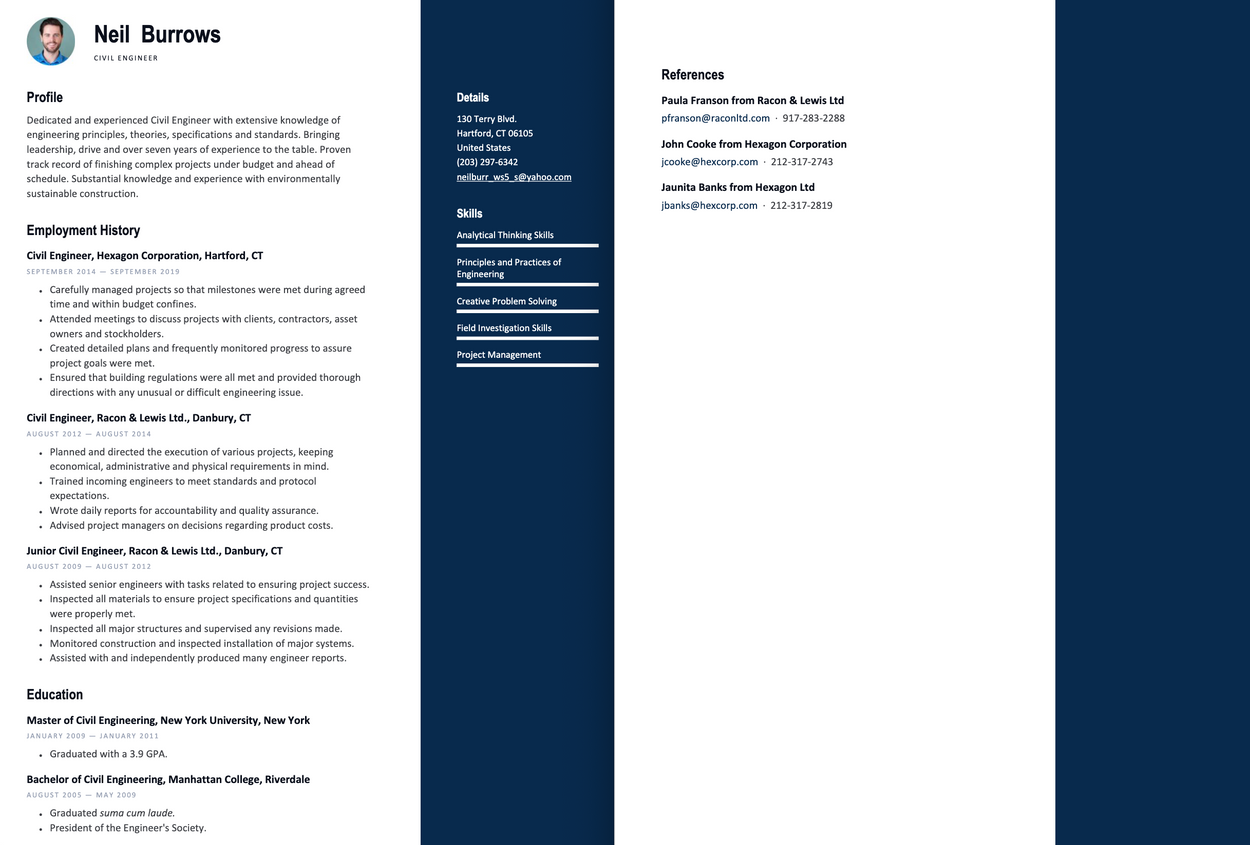
Even worse, this second reference page in a resume might be totally blank at the bottom, containing nothing but references, in just a few lines at the top. This kind of spill-over is never a good idea, and it suggests that you need to trim your text to hold your resume to one page.
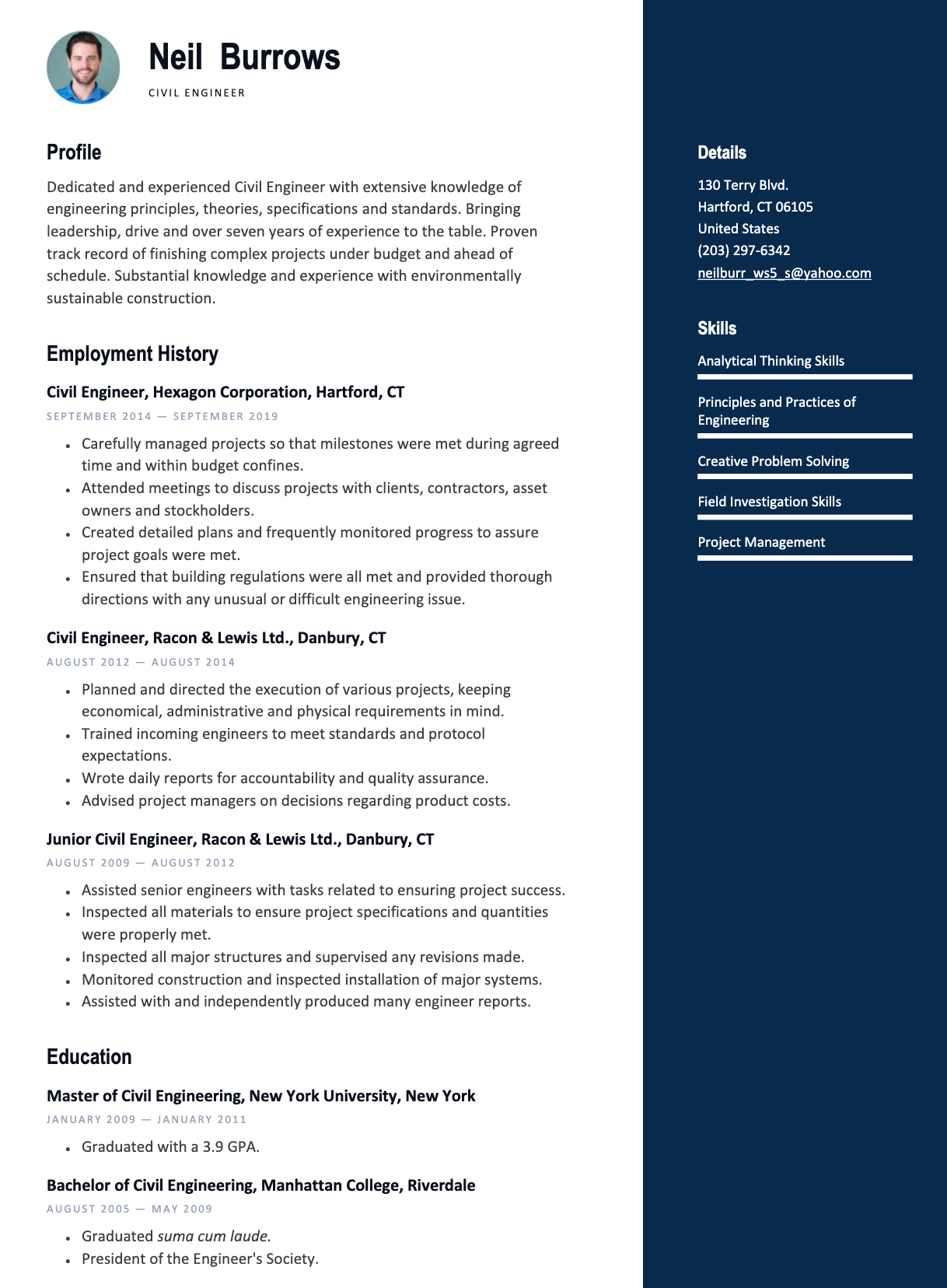
Resume without references
This resume has everything it needs and fits perfectly onto one page.
Resume with references
Including references often adds an unnecessary second page.
If you’re part of the more than 50% of the world’s population who speaks more than one language, you’ve probably wondered how to list languages on your resume . Your language skills could well be the missing link for your next boss.
This guide will go over:
- Whether or not you should include languages on your resume
- Understanding and writing about language fluency on a resume
- Examples showing various ways to include language skills on a resume
Should You List Languages on Your Resume?
The short answer depends on two things:
1. Your level of proficiency
2. How the language relates to the position
Make room for languages on your resume when it is a requirement for the position or feature it in a secondary area when it supports your professional skills . Employers like to know if you have a working capacity in other languages and it can be an added bonus in your application even if it’s not a requirement.
If your language proficiency ranges from professionally conversational to native (essentially, intermediate to advanced), it has a place on your resume. Whether you’re applying to be a barista or a senior marketing manager, a second language can help you communicate with customers, clients, and foreign offices.
Tailor your resume to the position, highlighting your language skills more or less depending on how much language lends to the role and is mentioned in the job posting.
Demand for bilingual employees spreads across the job market, from service positions to C-Level directors. That demand is growing quickly. In fact, 9 of 10 employers responding to a recent survey said they rely on English-speaking employees who also speak another language. That same survey (by Ipsos Public Affairs for the American Council on the Teaching of Foreign Languages or ACTFL) found that employers expect their need for multilingual employers to continue to grow.
How to assess your skill: language levels resume
You took Spanish in high school or maybe even in college. Does that qualify you to list Spanish as a second language on your resume? It depends
While you can prove soft skills like communication and organization over time, you can’t exactly skirt around being fluent in French. Before you find a home for languages on your resume, honestly assess your up-to-date comfort level with each language you’ve studied.
Language proficiency generally follows a 0-5 system:
0 – No proficiency.You’ve never studied the language
1 – Elementary. You can hold your own in very basic exchanges, such as greetings, asking for directions, etc. This level is typical for visiting another country and feeling confident getting around.
2 – Limited Working. Personal conversations come a bit more naturally, but your vocabulary is not necessarily extended to professional or complex topics.
3 – Working Professional. You can confidently chat with clients on the phone or make presentations in that language. It may still be clear that the language is not your native tongue, and you need assistance with certain phrases or vocabulary.
4 – Full Professional. At this level, you can weave between professional and personal topics with ease. You no longer need assistance translating complex ideas or terms and managers can trust you to hold your own in independent exchanges with clients.
5 – Native. The language is such a large part of your daily life that you barely have an accent and can assist others with translation. This level is typical of those raised on the language or have spoken it regularly for a large portion of their lives.
Although levels 1 and 2 are a step in the right direction, they rarely have practical application in an office setting—at least enough to mention on your resume. If the question were to come up in an interview specifically, it’s fine to show your dedication to learning and improving your language skills.
Overall, only list languages on your resume if your proficiency falls between levels 3 and 5.
How do you describe language skills?
Rather than rely on a list of your various linguistic qualifications, use language that a hiring manager would understand. Phrases such as "working professional" and "full professional" are much more useful than an IELTS or TOEFL qualification that they many may not understand. Alongside a widely understood language framework, this will offer the fairest assessment of your level. Equally, although you may have studied a language five years ago at university, be honest about your current level.
How to list languages on your resume
So how do you list languages in your CV? There are several ways to include your language skills. Some of them depend on which of the three formats of resumes you choose.
1. Language Sidebar. Information on a resume sidebar catches the eye, making the reader feel like it’s in a special spot for a reason. If the position specifically calls for language proficiency—and you meet the mentioned proficiency level—consider listing your languages in the sidebar.
In many of our resume templates, you can list skills and languages above the level of proficiency through the use of icons or bars. Either choose to create a full list of languages—if you speak multiple ones—or meld skills and language list into one sidebar display.
In this case, it may look something like this:
- Spanish
- French
- German
2. Within work experience. As you detail your skills and responsibilities underneath each job title, include a bullet point about your language use throughout the position. As always, stay honest—if a past employer ends up as a reference , language use could come up.
If language is a large part of the job requirements, place it toward the top of your responsibility list. Hiring managers may be looking for keywords as they make their initial pass over your resume, and including these phrases prove you understand the level of language proficiency they’re looking for.
For example:
Product Manager, Super SolutionsJanuary 2014-January 2018
Managed online and in-person correspondence with clients in France, acting as office point-person for French translation and negotiations.
3. Education. If studying a second or third language was a large part of your formal education—especially if it was a major or minor—note your language training in your education section as well. This could also expand your resume if you recently graduated and are looking to include unique information that speaks to your passions. In this case, you may consider including language honor’s societies, clubs or trips abroad where you stretched your language muscles in a practical setting.
In resume templates with a large focus on educational information, you may even detail your language studies and applications below the school name if you believe the hiring manager will benefit from learning more about this experience.
For example:
University of Southern Florida
Bachelor's in Finance January
- Minor in Spanish and International Relations
- President of Spanish Society
- Studied abroad with student organization in Argentina
So, you’ve got your resume all tuned up to apply for your next job as a “certified pubic accountant”? Um … you might have overlooked the importance of proofreading your resume.
A careful proofreading of your resume before sending it to an employer is absolutely mission-critical. Typos, misspellings, bad grammar or incorrect punctuation can all sink your chances of landing your next job.
A resume should usually be one page only — so exactly how many mistakes do you expect a hiring manager to tolerate in a single page? One is too many!
Why should you proofread your resume?
In the rush to send your application off, you might be tempted to give your resume a quick once over and leave it at that. However, given the amount of thought and effort that you have invested up to this point, why wouldn't you choose to be overly cautious about checking for mistakes?
A mistake on a resume will stay with you for the entirety of the hiring process. Multiple people who will ultimately influence the hiring decision will read it. Maybe one of them is a stickler for correct grammar. It only takes one person to form an unfavorable impression due to a mistake and you have a black mark that you could have avoided.
Why is it important to proofread your resume before sending it? This video should answer that question.
Consider the multiple ways of resume proofreading in the chapter below and spend more time than you think is required on this vital last task. You will surely find a mistake or two if you do. Why wouldn't you?
Proofread your resume alongside your cover letter.
While you might have employed a resume writer to craft your resume, make sure that your cover letter uses similar language. If the resume and cover letter sound different, alarm bells will ring for the hiring manager. Proofread and optimize both at the same time.
How do you proofread a resume?
Here are our top 5 tips to proofreading your resume so that you don’t miss anything important. (And again, it’s ALL important).
1. Reread it very slowly, word for word and line by line.
Resume proofreading, obviously, starts with rereading, but you need to do this slo-o-owly. Often when we read, our eyes absorb big chunks of text at once. You need to slow down the process to look at each word one by one, and each punctuation mark as well. In this phase of resume proofreading, you are not looking for context, simply focus on one word at a time.
Hint: Pumping up the magnification on your computer screen may help you.
2. Use editing tools like spellcheck and Grammarly.
Using spellcheck is a no-brainer, and you can also use programs like Grammarly that both spot errors and suggest improvements in syntax. But neither of these is foolproof — you could write “lead” instead of the past tense “led,” and a spellcheck might never catch it.
Hint: Avoid quickly accepting each suggestion. Really look at them and decide whether the suggestion is a good one. Spellcheck and Grammarly are not foolproof.
3. Eliminate repeated words.
Many resumes are rife with repeated words that should be deleted. You don’t want to say you’re a “passionate” schoolteacher and then say you have a “passion” for early childhood education. You don’t need to use the word “skills” three times in your skills section. Many writers have certain go-to phrases that they tend to repeat unconsciously. Try doing a search for some of the major words in your resume, and you might be surprised how often you repeat them.
Hint: Try running your resume and cover letter through a word art program like Wordle to see if you have too much repetition.
How long should you wait before proofreading?
Once you have finished writing your first draft of the resume, it is worth switching off and going to do something else. Ideally for quite some time. (Did you see the mistake in this paragraph? If you did, you’re well on your way to being a great proofreader. If not, go back and reread.)
Giving your brain time to reset will let it mull over its resume activity in the background, so when you come back to the document it will be as if you are reading it with fresh eyes. One or two mistakes will likely jump off the page and you will feel a desire to rewrite certain sections. Patience pays off with job search content.
4. Eliminate clichés.
Resumes are often a minefield of clichés, in part because so many of us look at other people’s resumes as models for how to write our own. Phrases like “self-starter,” “team player,” “results-oriented” and “thinking outside the box” are a few tired examples — and how many resumes boast of “strong communication skills”? When writing a resume, the first words that come to mind may well be a cliché. Try to use original language that you’ve never read on any other resume.
Hint: Use the tools at hand. Even the best writers employ a thesaurus to find interesting synonyms.
Only include relevant information, that way your resume won't be too long .
5. Check for missing material.
A comprehensive guide like Resume.io’s “ How to write a resume ” will provide you with a good list of all the elements your resume needs to include from the contact info in your header through the summary/profile, employment history , education and skills sections. As you carefully proofread all the text you already have, don’t forget to double-check for anything important you’re missing.
Hint: Develop a checklist and keep it handy as you proofread your resume.
If you are going for a job abroad and wonder whether international hiring managers have different expectations, you would be right to ask the question.
While the recruitment process will ask many of the same questions and request the same information in every country, some of the terminology can be confusing.
There are also a few subtle differences within certain countries, so let's explore some international resume writing tips in more detail.
This blog discusses the most common types of international resume rules, challenges, and tips, including:
- International resume introduction
- Why it matters to customize your resume for certain countries or cultures
- American resume
- the British CV
- Asian resume
- Spanish resume
- Russian resume
- Writing a CV when English is your second language
Depending on the location of the job you’re applying for, you may want to understand more about an international resume. For example, if you are applying to a job in the United Kingdom, the United States, or Asia there are specific rules to follow and customs that are expected of job applicants. The same is true for Russia or Spain.
Another challenge is if languages like English or Spanish are your second language, then there are aspects of creating an international resume that should be followed in order to improve your chances of getting an interview.
International resume introduction & writing a resume for international jobs
The first thing that you should do when applying internationally is to understand the expectations.
An international resume isn't so much a format, but rather a strategy to follow for aligning your resume with the local expectations and resume standards. The key to writing for an international audience is understanding more about expectations — what format do they prefer, do they want it translated, do they require references, a professional photo, or a portfolio?
There’s no one-size-fits-all strategy for an international resume, so be sure to check out the specifics below, do your research, and don't be afraid to ask locals for advice.
Tone is also very important depending on which country you’re applying in. For instance, American-style resumes are expected to be more self-promoting, whereas other countries, like China, you’re expected to be more modest.
International resume tip — More than any other resume, if you’re applying to a foreign country you need to be clear on your resume about your nationality, visa status, and language abilities. Whereas this isn’t important if you’re applying in your own country, this is critical information for international resumes.
What are some tips for a good resume?
The most important tip for a resume is to tailor it towards the role that you are applying for. Every sentence and achievement has to add to your case that you are the person for this specific job. The more irrelevant details there are, the less attention an employer will pay to what else is there.
The American resume
Modern American resumes are now done digitally, typically found in PDF or Microsoft Word format in order to easily upload and email.
Some people believe that an American style resume can only be one page, but that’s not necessarily true. If you have more than 5-7 years of relevant experience or are in an executive function, your resume should be two pages.
The most common form of American resume is the chronological resume , which follows along a structured style starting with your most recent position.
An American resume typically follows the format of:
- Personal information
- Professional summary statement
- Work history (in reverse chronological order)
- Education
- Hobbies(optional)
- Skills
- Certifications (optional)
- References (optional)
American resume tip — Make sure to understand the power of keywords. Many hiring processes and applications in the United States now involve the use of an Applicant Tracking System (ATS). An ATS helps employers organize and screen the hundreds of candidates who usually apply. Companies with high volumes of candidates use their ATS to automatically screen candidate resumes looking for certain keywords and phrases.
How to write an American resume and what to avoid
Rules, examples, and tips for writing an American resume when applying for a job in the United States. Convert your CV to an American resume following these resume tips and templates for the USA.
While most of the world uses a CV when looking for a job, in America the document most commonly used is a resume. An American resume differs from a CV in that it is a summary of a person’s work history, skills, education and other items an employer may be interested in. A CV , in the American sense, is very detailed and chronicles the person’s entire career with details about their achievements, publications, education and other items which are relevant to the job they are applying for. For the rest of the world, a CV is the same as an American Resume.
The only exception to using a resume in America is if you are applying for a job that is in either a technical or academic field. In these cases, you would default to a longer American CV.
In this guide, we will discuss the following critical components of writing an American resume:
- Differences between a resume and a CV
- The purpose of a resume
- How to organize
- Formatting an American resume
- What items you should and shouldn’t include.
- The individual components of an American resume
- How to optimize your resume
The purpose of an American resume
When creating a resume, keep in mind its purpose. A resume will not get you a job, rather it is intended to generate enough interest in you to get you invited to an interview. Surveys indicate that recruiters spend about 6 seconds reviewing a resume. Therefore, it is important that you capture the reader’s attention quickly and make the resume interesting enough so that they will want to continue reading it.
A good way to determine how much of your resume a recruiter will read before they decide about you is to fold the first page in half. This is the most important real estate on your resume, and you need to use it to communicate your qualifications as concisely and clearly as possible.
What are the 4 C's of resume writing?
- Creativity. Every job requires you to make something from nothing every now and again.
- Communication. Getting stuff done with others needs excellent oral and written communication.
- Collaboration. Knowing how to achieve results as a team is key to so many careers.
- Critical thinking. Every problem has multiple solutions - finding the right one is rarely simple.
General guidelines for an American resume
An American resume is constructed on Letter size, 8.5”x11” paper, in the portrait orientation. Modern American resumes are now done digitally , and are typically found in PDF format in order to easily upload and email.
Typically American resumes are either 1 to 2 pages, based on the length of your career. New graduates or people with limited experience can easily use just one page to describe their qualifications. People with more experience may need two or even three pages to cover their complete job history, accomplishments, education, skills and certifications.
A CEO will have a much longer resume than an intern. Simple as that.
When considering the content to include in your resume, a good guideline to follow is that if the information isn’t relevant to the job you are interested in then it should not be in your resume. Employers hire people for one of four reasons.
- You will make them money
- You will save them money
- You will save them time
- You will fix a problem
Keep these in mind when you are writing your resume. Another tip is to include some type of metric (i.e., $, #, %) in every 2-3 sentences. This captures the reader's attention and helps them recognize your contributions, with the assumption that you can do the same for them. There’s nothing worse than a recruiter reading some generic statement, like “Contributed to overall department success and team collaboration.”
What does that mean? What did you contribute and what were the results? What specifically did you do to promote teamwork? Be as specific as possible.
You can find resources which will help you when writing your resume across the internet. These will provide you with examples of effective resumes and templates you can follow while constructing your resume.

Build your resume in 15 minutes
Use professional field-tested resume templates that follow the exact ‘resume rules’ employers look for